The BBC and ITV’s failure to report on the Women’s Six Nations and what this means for the Women’s Rugby World Cup.
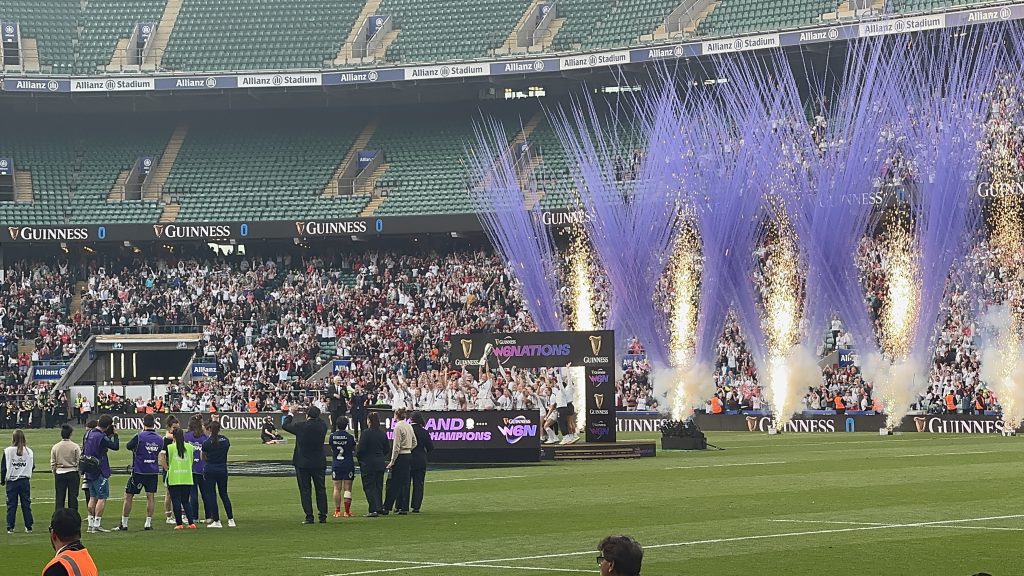
Red Roses winning the Women’s Six Natioons 2025 / Courtesy of Amelia Line
Earlier this year, six international rugby teams fought in the Women’s Six Nations to make history- one of the biggest sports competitions across the UK. But BBC and ITV’s reporting and streaming of this before, during and after was disappointingly sparse.
In the rugby community, it is no hidden fact that the Red Roses are world leaders after recently wining their historic Women’s Six Nations grand slam. But elsewhere in the country, and nation, few people know of England and the UK being represented so greatly.
“The final game of the Women’s Six Nations was probably one of the biggest games this year across all men’s and women’s sports, and it’s not been displayed in the right way, especially in the lead up to a huge home World Cup this summer,” says sports journalist Ashleigh Rollins.
After the BBC gained all streaming rights for the Women’s Six Nations 2025, it would have made sense for the UK’s biggest streaming service to regularly mention one of the greatest sports tournaments in the rugby calendar.
Even more so, when three of its streaming countries are involved in this tournament, and one was in the fight to make history yet again, bringing pride to UK and English women’s rugby.
On the final day of the six-week tournament, there was minimum talk of England’s feat across any BBC run services, apart from the BBC Sport live stream of the actual match. Unlike the men’s matches earlier in the year, the competition failed to appear on live TV.
This wasn’t just the case for England, with Wales and Scotland’s matches failing to be represented outside of their respective BBC TV services during this weekend. The two countries also failed to be mentioned elsewhere across the UK.
Outside of TV failings, the likes of BBC radio services also showed very little representation. BBC Radio 1, the company’s primary station, only mentioned the tournament twice across four days and seven shows of sports news. On both occasions, this was the penultimate or last sport mentioned following huge support of football, boxing and cricket.
These occasions were only then catered to existing fans and unlike all other sports news, failed to even mention what sport the tournament was for. The UK-wide broadcast also gave no mention of Wales and Scotland’s surrounding matches, leaving the final weekend of the competition as only an afterthought.
“People say there’s not enough interest in it. But if you look at the figures, there really is. [The BBC] had so much time to lead up to it because they’ve known they’ve had the coverage for a while. It’s a little bit disrespectful,” Rollins says.
It wasn’t just the BBC however, with ITV also partaking in resistance of the sport. Another of the UK’s biggest streaming companies failed to post any sports articles on the entire W6N, with the last women’s rugby article on their website from March.
Although ITV didn’t have streaming rights for the tournament, that did not stop the service from sharing news from other competitions that weekend where they lacked streaming. What’s more, the company fought and succeeded the ability to show some of the Men’s Six Nations matches earlier this year, an uncommon theme in the Women’s.
The news of historic results for Wales and England also failed to see light on Good Morning Britain, a news service for ITV. Frankie Harvey (@thatrugbygirll) advocated daily for the show to add W6N news to the other sports news in the following days:
“England’s most successful team ever, having set a new record for Grand Slams in a row didn’t even get a mention, not even 5 seconds of screen time. We have the Women’s Rugby World Cup here this year and they need to do better. I was angry, upset and generally let down if I’m honest,” she says.
“When I posted about it, I knew there would be some backlash, and there absolutely was. [Frankie’s dad] had to delete all the horrible messages because there were so many. All I wanted was for this amazing team to get some recognition for their achievements. I hoped Good Morning Britain would at least respond and explain why it wasn’t mentioned, but I didn’t hear anything.”
Women’s rugby has made a profit for the first time in the UK this year, something the men’s failed to do. 37,000 people sat in the stand of Allianz Stadium, Twickenham during the final Red Roses match and the BBC received a record 8.1 million views during last year’s W6N according to the Women’s Sport Trust.
2025 has developed a narrative as being ‘The Year of Women’s Rugby’, but the sport’s monumental year has received not even half the media as a men’s regular year. The scope of women’s rugby is building, but it can only continue to grow to new fans if they can see and hear about it.
“Having it there to watch makes a huge difference for people all around the world. If you don’t see it, you don’t know about it. When I was younger, I didn’t know women’s sports was a thing- I grew up wanting to be a male footballer because I didn’t know women played football,” says Rollins.
Harvey expands this mindset: “If we see it, we can be it. It’s simple. The more it’s spoken about, the more acceptable it becomes. The more normalised it becomes, the bigger the sport gets and the better it becomes for all of us.”
And with the BBC holding rights for the Women’s Rugby World Cup 2025, we’ll see if the failings in coverage will continue across the summer. Her Try contacted the BBC, ITV and Good Morning Britain but all failed to comment.
Leave a Reply